.svg)


If automation triggers represent the starting point of every automation workflow, the automation and orchestration engine is the place where those intentions are processed into controlled, secure, and productive action.
As the “brain” of a modern automation strategy, it is a central layer that interprets requests, enforces policies, orchestrates workflows, and ensures that every action executed across the Microsoft ecosystem is consistent, auditable, and aligned with enterprise objectives.
Where older scripting approaches relied on loosely distributed scripts running on individual admin workstations, modern automation requires a governed execution environment — the basis of any enterprise PowerShell automation model.
This is especially critical as we move into the era of agentic automation, where AI-driven workflows have the power to take action autonomously. Without a robust automation and orchestration engine, even simple tasks can become fragmented; with one, automation becomes reliable, scalable, and safe.
This article introduces the core components of the automation and orchestration engine and shows how ScriptRunner turns automation from a scattered collection of scripts into an enterprise-grade operating system.
The Automation and Orchestration Engine: A Unified Control Plane for Modern Enterprises
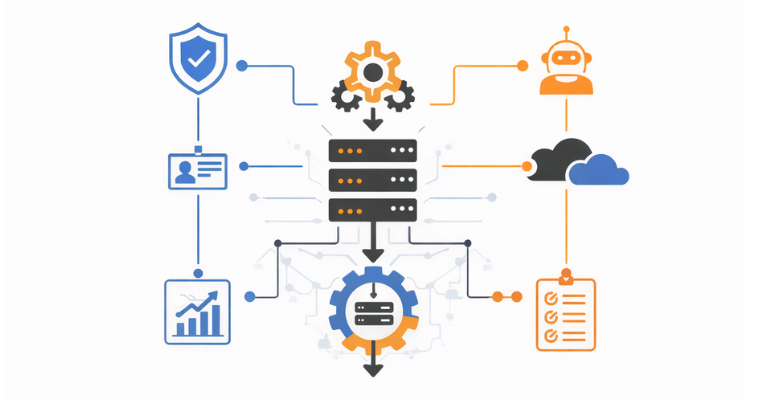
At its heart, a modern automation and orchestration engine performs three essential functions:
- Interprets triggers and input, whether they come from humans, schedules, events, or AI agents.
- Executes workflows under strict governance, ensuring actions run with the correct permissions, policies, and validated logic.
- Orchestrates all systems across the Microsoft ecosystem, such as Azure, Active Directory, M365, Intune, SharePoint, SQL, hybrid datacenters, and more.
- Integrates seamlessly with IDM, CI/CD, ITSM and all other important infrastructural components
ScriptRunner acts as this unified automation and orchestration control plane. It consolidates execution, identity governance, access policies, auditing, and monitoring into a single platform, eliminating the inconsistency that emerges when different teams run automations through different tools.
Unlike traditional orchestration approaches, ScriptRunner also supports the next generation of automation. It acts as the foundation for workflows that combine deterministic logic with adaptive behavior from AI agents while maintaining full transparency and control.
Let’s break down the major layers of the automation engine.
Human-Initiated Automation: Where Control is Paramount
Many automation processes require some form of human input, particularly high-risk actions that need approval before they proceed.
ScriptRunner enables this safely by:
- Providing clean, role-based UI surfaces through portals and embedded widgets.
- Automatically generating policy-controlled input forms with validation and guardrails.
- Escalating approval requests for high-risk or sensitive tasks.
- Ensuring users can trigger automations without elevated privileges.
This approach removes repetitive manual effort while eliminating the risks of individuals running ad-hoc scripts on local machines or cloud services. ScriptRunner ensures that every user-triggered automation, whether started by an IT admin or an end user, runs inside a governed environment with full logging and policy enforcement.
Centralized governance is the difference between creating and running workflows, tasks, and agentic automation in isolation, and triggering secure, approved automations through a self-service portal. Both of these support individual autonomy to use automation in daily work, but only the latter ensures that it is done securely and in alignment with compliance standards.
Scheduled Automation: Consistency and Compliance Without Human Effort
Some of the most valuable automations run invisibly in the background, driven by time-based schedules that enforce routine hygiene and compliance.
Examples include:
- Daily configuration checks
- End-of-month license and usage reports
- Removal of stale accounts or unused groups
- Continuous data processing
- Recurring policy validation for devices and workloads
A mature automation and orchestration engine becomes the authoritative source of truth for when, how, and under what rules these recurring workflows operate.
ScriptRunner strengthens this layer by providing centralized scheduling that replaces the inconsistent, hard-to-govern model of decentralized CRON jobs and per-system task schedulers.
With ScriptRunner, IT teams gain:
- Central management of all schedules across the environment
- Policy-enforced execution, permissions, and access controls
- Unified logging and reporting for compliance and audits
- Pause and maintenance-window handling
- Multiple schedules per task, each with unique parameters, targets, or timing
This eliminates configuration drift, reduces the risk of forgotten tasks or outdated scripts, and ensures that every scheduled workflow operates predictably and securely.
Workflow and Task Automation: Orchestration Across Systems
Structured workflows remain the backbone of enterprise automation. These orchestrated sequences reflect real business processes and often span multiple systems across the Microsoft landscape.
A strong automation and orchestration engine manages these workflows centrally, enabling teams to:
- Standardize the logic behind each process, as workflows run across business functions, tools, and systems.
- Reuse building blocks across departments to eliminate duplicated effort.
- Ensure compliance with policy and logging at every step, no matter where automation runs.
- Maintain consistency as systems evolve and scale.
ScriptRunner provides this by:
- Centralizing execution logic so workflows behave consistently regardless of origin.
- Allowing teams to build reusable automation building blocks.
- Enforcing uniform logging, RBAC, policy checks, and script signing.
- Providing connectors and integrations that tie Azure, M365, AD, SQL, on-prem servers, and third-party APIs into unified workflows.
This centralization is what transforms automation from scattered scripts into coordinated, cross-system workflows across the Microsoft Ecosystem.
Without a platform like ScriptRunner, workflow orchestration collapses under inconsistent permissions, incompatible dependencies, and lack of visibility across teams.
Agentic Automation: The Next Evolution of the Automation and Orchestration Engine
As AI agents begin to take on more autonomous responsibility, proactively triaging incidents, remediating issues, provisioning accounts, interpreting system signals, the automation and orchestration engine becomes even more critical.
Without guardrails, agentic automation is dangerous. With the right automation and orchestration engine, it can scale to become a core part of enterprise-grade systems.
ScriptRunner provides the guardrails that make agentic automation viable by offering:
- A controlled execution environment for AI agents, with rigorous role-based access, least privilege, and conditional access enforcement.
- Policy-driven boundaries that ensure AI agents can only act within their designated scope.
- Human-in-the-loop approvals for high-risk operations.
- Full logging and traceability for every action performed by agents.
- Real-time monitoring and performance tracking to validate contribution to enterprise goals and enable informed optimization.
This gives organizations the confidence to allow AI to automate meaningful stages of their operational workload, while maintaining oversight and security.
Helper Systems: The Supporting Infrastructure That Makes Automation Work
A modern automation and orchestration engine doesn’t operate alone; it is supported by systems that enhance security, visibility, and reliability. ScriptRunner integrates directly with these helper systems, including:
- Identity Management platforms (IDM) to authenticate users and agents, enforce RBAC, and govern delegate permissions.
- Monitoring and SIEM solutions to watch over executions, detect anomalies, and centralize security signals.
- CI/CD pipelines to version, test, and deploy scripts and workflows using DevOps best practices.
- Connectors and integrations enabling communication with external APIs, ticketing systems, HR tools, and operational databases.
Together, these helper systems allow automation to exist not as isolated tasks, but as a structured operational backbone.
Output Systems: Turning Automation Into Measurable Value
Automation is only as useful as the results it produces. Output systems transform raw activity into actionable insights and business value.
ScriptRunner provides output systems that transform automation into enterprise insight:
- Dashboards showing execution trends, success rates, and time savings.
- Consistent logging and audit trails, with reports for IT leadership or compliance teams.
- Notification systems that alert teams to issues or required human-in-the-loop approvals.
These outputs enable measurable productivity gains, support regulatory compliance, and help teams to continually refine their automation capability.
Why a Unified Automation and Orchestration Engine Matters Now More Than Ever
As enterprises shift toward agentic automation, the centralized automation and orchestration engine becomes the foundation that enables scale, safety, and operational excellence.
Without it, automation remains fragmented, with unpredictable scripts running in silos, AI agents acting without guardrails, and workflows that break as systems evolve.
With ScriptRunner at the center of the automation architecture:
- All triggered workflows run consistently across systems.
- Policies and permissions are enforced automatically.
- AI agents operate safely inside controlled boundaries.
- Errors are easier to identify, trace, and resolve.
- Insights become measurable, auditable, and actionable.
ScriptRunner is the engine transforms automation from a chaotic ecosystem into a unified, governed, enterprise-grade system built for the future of agentic automation.
In Part 4, we’ll shift focus to the automated systems themselves: the environments where execution happens, and where value emerges.
If you’re ready to modernize your automation engine today, book a meeting with ScriptRunner.