Replace

Stonebranch

with Scriptrunner

Purpose-built for Microsoft Ecosystems.
Native by design, not bolted on like our competitors.


For Enterprise IT Teams Running Microsoft‑centric Environments
Cut Ticket Volume, Standardize Scripts, And Stay Audit‑ready

Dundee Precious Metals LogoBooking.com LogoUzin_utzRaymond Chabot LogoDrexel_Universitynavy-copy-svBechtle LogoMaine HealthGetinge Logo

Why users prefer ScriptRunner?

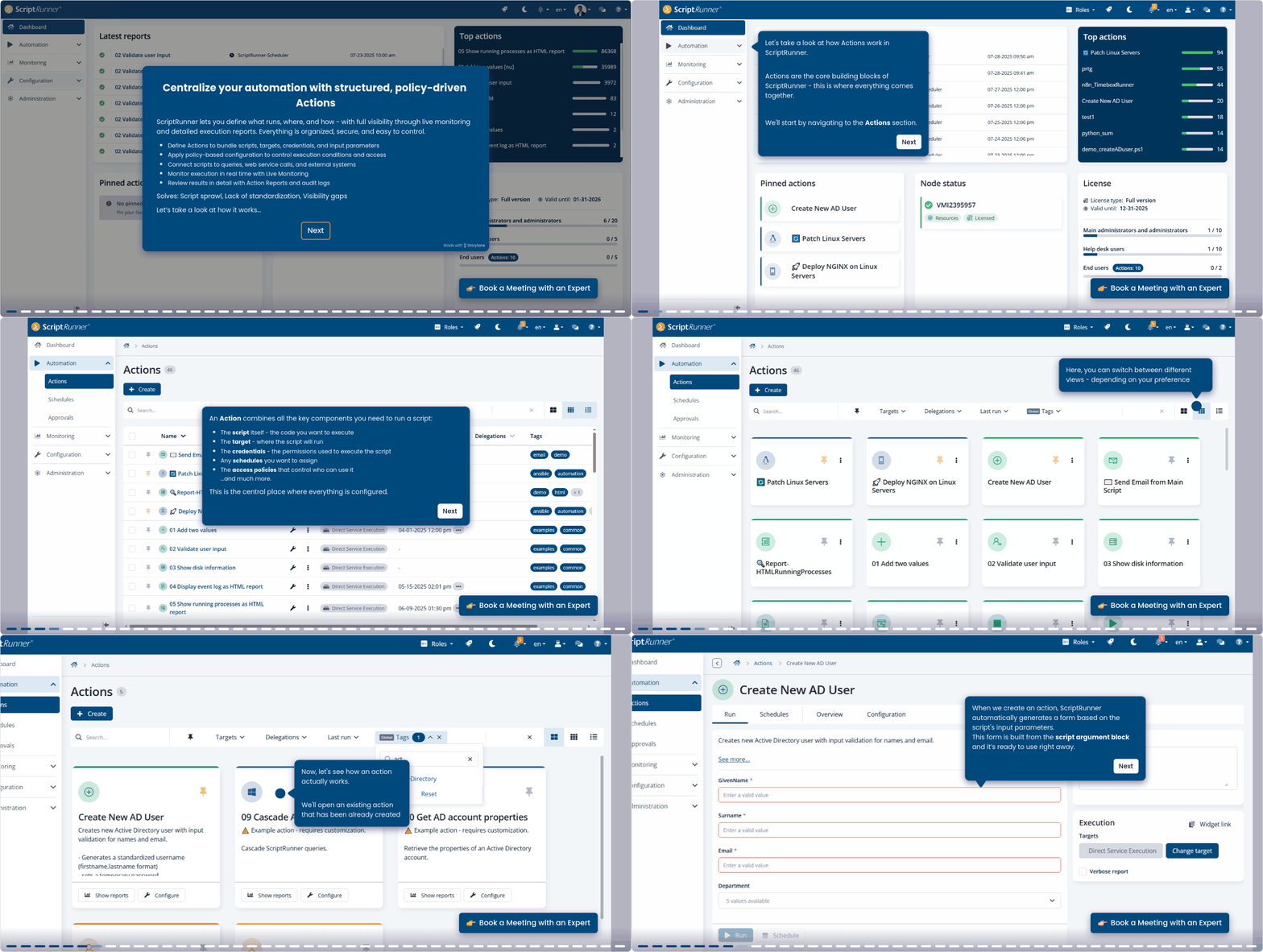
Purpose‑built PowerShell execution

Delivers native PowerShell execution with full control, eliminating indirect agent‑based layers used in Stonebranch’s workflows, which add unnecessary orchestration complexity

Governance‑ready automation by design

Provides credential vaulting, RBAC, and centralized audit trails, addressing compliance risks introduced when PowerShell scripts pass through Stonebranch’s Universal Agent

True operational task delegation

Enables service desk and departments to safely run PowerShell tasks via governed forms—unlike Stonebranch’s focus on batch job scheduling and incident‑driven workflows

Faster time‑to‑value with lower complexity

Avoids WLA‑level complexity, eliminating multi‑layer orchestration, agent setup, and enterprise‑grade workflow expertise required for Stonebranch deployments

Predictable cost structure

Offers transparent, task‑focused licensing, contrasting Stonebranch’s quote‑based enterprise pricing that scales with workload volume and increases cost unpredictability

Why consider ScriptRunner as a
replacement for  

Stonebranch

SR vs. Stonebranch - Platform
Overview
Operational Risk
Time-to-Value
Target Persona Fit
Scaling & HA
ScriptRunner
Enterprise-grade automation and orchestration platform with policy-driven governance, scalability, and audit readiness for operational excellence
Scripts run in controlled environments with policies and approvals, reducing the chance that “one bad script” destabilizes the platform
dmins get usable, governed automation quickly through templates and connectors, without having to build an app framework first
Aligns with IT ops realities: tickets, change windows, compliance audits, onboarding/offboarding, and cross‑team execution
Marketed explicitly for HA and horizontal scaling as a central automation and orchestration platform across the enterprise
Stonebranch
An enterprise workload automation system built for batch scheduling and ERP orchestration, not operational task automation—PowerShell is secondary, requiring orchestration layers and agent‑based execution
Dependence on agents, external interpreters, and multi‑layer workflows adds complexity and failure points, increasing operational risk for environments needing straightforward, governed PowerShell‑driven task execution
Achieving results requires mastering scripting, agent deployment, and SOAP architecture—delaying productivity and slowing teams who need fast, repeatable operational automation without heavy engineering
Designed for enterprises running massive batch jobs across SAP, ETL, and mainframe workflows—not for IT operations teams needing agile, on‑demand administrative task automation
Engineered for huge batch‑processing volumes, but this scale comes with architectural weight—agents, dependencies, and interpreter layers complicate scaling simple operational automations across diverse teams
SR vs. Stonebranch - Automation Model
Agentic Automation
Workflows
Task Automation
Scheduling
Automation Area
ScriptRunner
Delivers agentic automation with built-in governance, enabling secure, policy-driven orchestration across Microsoft ecosystems. It’s AI-powered, scalable, and compliance-ready
Automates and orchestrates complete workflows (webhook, event-driven, interactive, scheduled) with built-in governance, delegation, and compliance
Delivers secure, policy-driven task automation with intelligent workflows, enabling centralized orchestration, central script repository, compliance, and delegated execution
Offers enterprise-grade scheduling (controlled and delayed) enabling secure, policy-driven execution with centralized orchestration, compliance, and audit-ready workflows
Enables secure, governed automation across all major IT environments, including Public Cloud (Azure, Microsoft 365), Private Cloud, Hybrid Cloud, Data Centers, and Infrastructure
Stonebranch
Built for workload and batch orchestration, not autonomous operational decision‑making. Automation depends on scheduled workflows and interpreter layers, offering no native intelligence for real‑time, PowerShell‑centric operational actioning
Workflows rely on scripting, multi‑step job chains, and agent‑based orchestration designed for SAP, ERP, and mainframe pipelines—not lightweight, governed workflows for everyday IT operational tasks
Task execution happens through external interpreters on agents, treating PowerShell as a secondary script type—adding layers that slow down simple IT task automation and hinder operational agility
Scheduling is optimized for high‑volume batch jobs and complex dependency trees, making even routine operational tasks require enterprise‑grade job definitions instead of simple, on‑demand automation
Purpose‑built for enterprise batch processing, ETL workflows, and cross‑platform workload orchestration—not for PowerShell‑driven IT operations, service‑desk delegation, or rapid administrative task automation
SR vs. Stonebranch - Enterprise Governance & Business Enablement
Compliance & Audit Readiness
Safe Delegation & Self-Service
Scalability & Reliability
Version Control & Policy Enforcement
Business Outcomes & ROI
ScriptRunner
Built-in credential vaults, RBAC, and audit-ready logs ensure regulatory compliance without manual effort
Secure portals and forms empower non-technical users while maintaining governance and control
Multi-node execution and SLA-backed performance deliver consistent automation at enterprise scale
Centralized versioning and policy-driven workflows prevent privilege sprawl and unauthorized changes
Accelerates time-to-value with prebuilt templates, reducing risk and lowering TCO for measurable ROI
Stonebranch
A workload‑automation system running tasks through Universal Agents and external interpreters offers no PowerShell‑native governance, creating gaps in auditing, privileged control, and compliance for operational script execution
Designed for enterprise batch processing, it lacks a safe, PowerShell‑centric delegation model—non‑technical users cannot execute tasks reliably without deep WLA knowledge and complex workflow configuration
Architected for massive batch‑job environments, scaling simple operational automation becomes burdensome due to agent deployments, orchestration layers, and interpreter‑based execution paths
Workflows rely on enterprise job‑scheduling constructs rather than centralized PowerShell governance, making policy enforcement, parameter control, and standardized task execution difficult across operations teams
Engineered for SAP, ETL, and mainframe workloads, its complexity and cost structure deliver ROI only in large WLA environments—not in everyday IT operational automation scenarios
SR vs. Stonebranch - Delegation, security & compliance
Delegation Model
Self‑Service UX
Approvals & Change
Audit & Compliance Stance
Security
ScriptRunner
Opinionated, policy‑driven delegation out of the box: who can run what, where, and with which parameters is a first‑class concept
Non‑admins use a ready‑made Delegate portal; admins publish safe actions and ScriptRunner generates the UI
Integrated approval workflows and change tracking make it straightforward to align with ITIL and audit demands
Designed to be professional in front of auditors: central logs, reports, and clear role/rights separation
Built-in credential vaults, RBAC, approval workflows, audit-ready logs, and safe delegation portals for non-technical users
Stonebranch
Built for batch scheduling, not operational task delegation. PowerShell runs through Universal Agents inside workload‑orchestration workflows, offering no native, governed, or role‑specific delegation model for IT operations
Designed around enterprise job definitions and workload pipelines, not user‑friendly task execution. Non‑technical staff cannot trigger PowerShell tasks without navigating complex WLA constructs and agent‑based workflows
Workflow changes follow enterprise batch‑processing logic, lacking streamlined approvals, parameter governance, and controlled operational change processes required for routine, high‑frequency IT task automation
Running PowerShell through external agents and interpreter layers limits visibility into execution context and privileged access, creating governance gaps for teams needing auditable operational automation
Indirect PowerShell execution via Universal Agents introduces extra surfaces and orchestration layers, complicating credential protection and secure handling of operational scripts in everyday IT workflows
SR vs. Stonebranch - Integrations, extensibility & support
Integration Stack
ITSM & Monitoring
Extensibility Model
Operational Complexity
Support & Safety Net
ScriptRunner
Native Microsoft ecosystem integration, ITSM connectors, IdM integrations, and enterprise-grade support with SLAs
Comes with patterns and connectors for ServiceNow, Jira, Matrix42, PRTG, Icinga, SCOM and more
Extend by adding new PowerShell actions into a governed framework - The platform enforces consistency
Designed to reduce day‑2 complexity: central monitoring of runs, standardized delegation, and reporting as table stakes
Enterprise‑grade support, guidance, and patterns tailored to IT operations teams, not just developers, plus SLA‑backed help and onboarding
Stonebranch
Built for enterprise workload automation with integrations spanning SAP, ETL pipelines, mainframe, Linux, and Windows, but oriented toward batch processing rather than PowerShell‑centric IT operations automation
Optimized for orchestrating system‑to‑system workflows, not ITSM‑driven operational tasks. Integrations focus on ERP and data pipelines, leaving service‑desk and monitoring‑aligned automation needs underserved
Extensibility depends on Universal Agent–based task execution and WLA constructs. PowerShell runs as one script type among many, requiring additional orchestration layers instead of native extensibility
Agent deployments, interpreter‑based execution, and batch‑oriented workflow design introduce significant operational overhead, complicating lightweight automation scenarios and slowing responsiveness for IT operations teams
Enterprise‑grade migration and implementation services target large WLA conversions, not ongoing operational automation needs—creating a support model aligned to batch environments rather than everyday IT tasks
SR vs. Stonebranch - Platform ScriptRunner Stonebranch
Overview Enterprise-grade automation and orchestration platform with policy-driven governance, scalability, and audit readiness for operational excellence An enterprise workload automation system built for batch scheduling and ERP orchestration, not operational task automation—PowerShell is secondary, requiring orchestration layers and agent‑based execution
Operational Risk Scripts run in controlled environments with policies and approvals, reducing the chance that “one bad script” destabilizes the platform Dependence on agents, external interpreters, and multi‑layer workflows adds complexity and failure points, increasing operational risk for environments needing straightforward, governed PowerShell‑driven task execution
Time-to-Value dmins get usable, governed automation quickly through templates and connectors, without having to build an app framework first Achieving results requires mastering scripting, agent deployment, and SOAP architecture—delaying productivity and slowing teams who need fast, repeatable operational automation without heavy engineering
Target Persona Fit Aligns with IT ops realities: tickets, change windows, compliance audits, onboarding/offboarding, and cross‑team execution Designed for enterprises running massive batch jobs across SAP, ETL, and mainframe workflows—not for IT operations teams needing agile, on‑demand administrative task automation
Scaling & HA Marketed explicitly for HA and horizontal scaling as a central automation and orchestration platform across the enterprise Engineered for huge batch‑processing volumes, but this scale comes with architectural weight—agents, dependencies, and interpreter layers complicate scaling simple operational automations across diverse teams
SR vs. Stonebranch - Automation Model ScriptRunner Stonebranch
Agentic Automation Delivers agentic automation with built-in governance, enabling secure, policy-driven orchestration across Microsoft ecosystems. It’s AI-powered, scalable, and compliance-ready Built for workload and batch orchestration, not autonomous operational decision‑making. Automation depends on scheduled workflows and interpreter layers, offering no native intelligence for real‑time, PowerShell‑centric operational actioning
Workflows Automates and orchestrates complete workflows (webhook, event-driven, interactive, scheduled) with built-in governance, delegation, and compliance Workflows rely on scripting, multi‑step job chains, and agent‑based orchestration designed for SAP, ERP, and mainframe pipelines—not lightweight, governed workflows for everyday IT operational tasks
Task Automation Delivers secure, policy-driven task automation with intelligent workflows, enabling centralized orchestration, central script repository, compliance, and delegated execution Task execution happens through external interpreters on agents, treating PowerShell as a secondary script type—adding layers that slow down simple IT task automation and hinder operational agility
Scheduling Offers enterprise-grade scheduling (controlled and delayed) enabling secure, policy-driven execution with centralized orchestration, compliance, and audit-ready workflows Scheduling is optimized for high‑volume batch jobs and complex dependency trees, making even routine operational tasks require enterprise‑grade job definitions instead of simple, on‑demand automation
Automation Area Enables secure, governed automation across all major IT environments, including Public Cloud (Azure, Microsoft 365), Private Cloud, Hybrid Cloud, Data Centers, and Infrastructure Purpose‑built for enterprise batch processing, ETL workflows, and cross‑platform workload orchestration—not for PowerShell‑driven IT operations, service‑desk delegation, or rapid administrative task automation
SR vs. Stonebranch - Enterprise Governance & Business Enablement ScriptRunner Stonebranch
Compliance & Audit Readiness Built-in credential vaults, RBAC, and audit-ready logs ensure regulatory compliance without manual effort A workload‑automation system running tasks through Universal Agents and external interpreters offers no PowerShell‑native governance, creating gaps in auditing, privileged control, and compliance for operational script execution
Safe Delegation & Self-Service Secure portals and forms empower non-technical users while maintaining governance and control Designed for enterprise batch processing, it lacks a safe, PowerShell‑centric delegation model—non‑technical users cannot execute tasks reliably without deep WLA knowledge and complex workflow configuration
Scalability & Reliability Multi-node execution and SLA-backed performance deliver consistent automation at enterprise scale Architected for massive batch‑job environments, scaling simple operational automation becomes burdensome due to agent deployments, orchestration layers, and interpreter‑based execution paths
Version Control & Policy Enforcement Centralized versioning and policy-driven workflows prevent privilege sprawl and unauthorized changes Workflows rely on enterprise job‑scheduling constructs rather than centralized PowerShell governance, making policy enforcement, parameter control, and standardized task execution difficult across operations teams
Business Outcomes & ROI Accelerates time-to-value with prebuilt templates, reducing risk and lowering TCO for measurable ROI Engineered for SAP, ETL, and mainframe workloads, its complexity and cost structure deliver ROI only in large WLA environments—not in everyday IT operational automation scenarios
SR vs. Stonebranch - Delegation, security & compliance ScriptRunner Stonebranch
Delegation Model Opinionated, policy‑driven delegation out of the box: who can run what, where, and with which parameters is a first‑class concept Built for batch scheduling, not operational task delegation. PowerShell runs through Universal Agents inside workload‑orchestration workflows, offering no native, governed, or role‑specific delegation model for IT operations
Self‑Service UX Non‑admins use a ready‑made Delegate portal; admins publish safe actions and ScriptRunner generates the UI Designed around enterprise job definitions and workload pipelines, not user‑friendly task execution. Non‑technical staff cannot trigger PowerShell tasks without navigating complex WLA constructs and agent‑based workflows
Approvals & Change Integrated approval workflows and change tracking make it straightforward to align with ITIL and audit demands Workflow changes follow enterprise batch‑processing logic, lacking streamlined approvals, parameter governance, and controlled operational change processes required for routine, high‑frequency IT task automation
Audit & Compliance Stance Designed to be professional in front of auditors: central logs, reports, and clear role/rights separation Running PowerShell through external agents and interpreter layers limits visibility into execution context and privileged access, creating governance gaps for teams needing auditable operational automation
Security Built-in credential vaults, RBAC, approval workflows, audit-ready logs, and safe delegation portals for non-technical users Indirect PowerShell execution via Universal Agents introduces extra surfaces and orchestration layers, complicating credential protection and secure handling of operational scripts in everyday IT workflows
SR vs. Stonebranch - Integrations, extensibility & support ScriptRunner Stonebranch
Integration Stack Native Microsoft ecosystem integration, ITSM connectors, IdM integrations, and enterprise-grade support with SLAs Built for enterprise workload automation with integrations spanning SAP, ETL pipelines, mainframe, Linux, and Windows, but oriented toward batch processing rather than PowerShell‑centric IT operations automation
ITSM & Monitoring Comes with patterns and connectors for ServiceNow, Jira, Matrix42, PRTG, Icinga, SCOM and more Optimized for orchestrating system‑to‑system workflows, not ITSM‑driven operational tasks. Integrations focus on ERP and data pipelines, leaving service‑desk and monitoring‑aligned automation needs underserved
Extensibility Model Extend by adding new PowerShell actions into a governed framework - The platform enforces consistency Extensibility depends on Universal Agent–based task execution and WLA constructs. PowerShell runs as one script type among many, requiring additional orchestration layers instead of native extensibility
Operational Complexity Designed to reduce day‑2 complexity: central monitoring of runs, standardized delegation, and reporting as table stakes Agent deployments, interpreter‑based execution, and batch‑oriented workflow design introduce significant operational overhead, complicating lightweight automation scenarios and slowing responsiveness for IT operations teams
Support & Safety Net Enterprise‑grade support, guidance, and patterns tailored to IT operations teams, not just developers, plus SLA‑backed help and onboarding Enterprise‑grade migration and implementation services target large WLA conversions, not ongoing operational automation needs—creating a support model aligned to batch environments rather than everyday IT tasks

Don't miss the opportunity to scale now

Book Demo
ScriptRunner Logo light