.svg)
.svg)

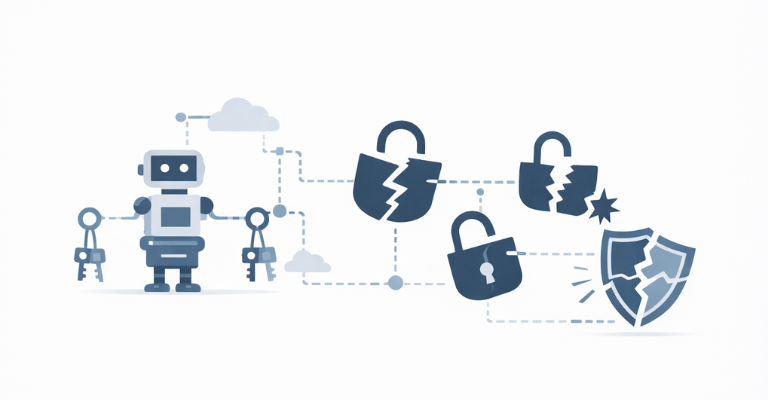
Least-privilege access is a foundational principle of enterprise security. Give every user, system, or process only the permissions it needs, and no more. This is a key part of limiting the blast radius of intrusions, reducing internal misuse, and meeting compliance requirements.
As agentic automation becomes more common and AI-driven agents are given access tools and databases to perform routine tasks, organizations must ensure that least privilege still holds. Adoption of AI in enterprise environments has already raised security concerns, and this will only increase as attackers get better at exploiting the autonomy granted to AI agents to perform their roles.
The core of the issue is that AI agents have the same capacity for action that human users do, such as querying databases, making changes, triggering workflows, generating operational insights, and so on.
In theory, if every agent is assigned tightly scoped permissions, the same way a human would be, the risk of exploitation should remain controlled. Unfortunately, this is often forgotten in real-world automation environments, where AI agents are treated more as impersonal automation tools than as active users in the system. As a result, access controls are negligently applied, and the principle of least privilege is quietly eroded.
Why Least Privilege Gets Ignored with AI Agents
The reasons for least privilege breaking down when agentic automation is introduced to IT operations are many, but a large part of the problem is human psychology.
AI agents have arrived with a high weight of expectation for quick, visible results. IT leaders are under pressure to demonstrate productivity gains and ROI, and teams are encouraged to experiment rapidly, prove value fast, and begin integrating it with core operational systems.
Unfortunately, as pressure mounts and teams take shortcuts to get agentic automation working as soon as possible, security is often treated as a secondary concern. The British Standards Institution, for example, found that while 62% of business leaders expect to increase investment in AI in the next year, only 24% have an AI governance program, and only 30% have processes to assess the risks and mitigations involved.
Humans naturally follow the path of least resistance. If an agent needs to “just work” across multiple systems, the simplest solution is to grant broad permissions and refine them later.
This behavior is exacerbated by the fragmented automation environments commonly found in large organizations. Automation has evolved reactively, with teams building tools and scripts to solve immediate problems rather than designing for long-term system health. The negative consequences of this fragmentation are well documented.
When agentic automation is introduced into this fragmented landscape of tools, platforms, and legacy systems, fine-grained access control becomes genuinely difficult. Even a “simple” agentic workflow may trigger in one platform, execute actions in another, call multiple APIs, and interact with both cloud and on-prem systems. Each of these systems brings its own identity model, credential format, and access granularity.
Precisely tailoring permissions across this landscape to according to least privilege is complex and time-consuming, especially for engineers under pressure to meet delivery timelines and productivity targets. Teams respond with pragmatic trade-offs:
- Permissions are widened to avoid blockers.
- Tokens are shared between workflows.
- Credentials are reused across agents instead of being tightly scoped.
As pilots mature and start moving into production, what starts as a temporary shortcut becomes another embedded security gap. Left unaddressed, this turns into a serious structural flaw.
Enterprise Risks Caused by Uncontrolled Access
Uncontrolled access in AI-driven automation does not create a single, isolated risk that can be easily fixed later. When left to run, it extends and amplifies its effect across systems, impacting productivity, security, and compliance in ways that are often difficult to detect until damage has been done.
First, productivity and output quality begin to degrade.
When AI agents operate with overly broad or inconsistent access, they don’t always act on the same data, follow the same execution paths, or produce the same results with each run.
Given permissions that exceed the scope of their intended tasks, agents may pull information from unintended sources, execute in the wrong place, and create unpredictable system changes as a consequence. The result is reduced reliability and a gradual erosion of trust in automation. Instead of accelerating work, ungoverned AI agents introduce errors that need to be traced and remediated with manual effort, steadily diminishing returns on investment.
Second, uncontrolled access creates exploitation paths for attackers that are extremely difficult to anticipate in advance.
Each over-provisioned credential, reused token, or loosely governed agent expands the attack surface for attackers to exploit. Attackers don’t need to compromise core systems directly; they can look for indirect pathways created by misconfigured agents with access to those systems as part of their privileges. These pathways are rarely documented in risk assessments and are often invisible to security teams, forming a growing “shadow” attack surface as agentic automation scales. What seems manageable as an individual tool can turn into a vulnerability when lost in the complexity of the broader system.
Third, the absence of centralized control makes tracking and traceability extremely difficult.
When automation spans multiple platforms with fragmented identity models and inconsistent logging while operating at machine speed, security and compliance teams struggle to answer basic questions:
- Which agent executed this action?
- Under whose authority?
- Using which credentials?
- Was that access explicitly approved?
Errors propagate across systems without clear ownership. Troubleshooting becomes slow and reactive. In the event of a security incident, tracing attacker activity or proving the scope of impact becomes equally challenging, increasing both operational downtime and exposure.
Taken together, these issues compound. Inconsistent automation outcomes undermine productivity and ROI. Hidden access paths introduce serious security vulnerabilities. Limited traceability weakens incident response and audit readiness. The result is an environment where agentic automation creates more problems than it solves, despite significant investment.
Without a centralized control mechanism for configuring and enforcing least-privilege for AI agents by default, agentic automation has little chance of integrating with critical operational systems and delivering on its promised value.
How a Centralized Approach Flips This on its Head
The root cause of the challenges outlined above isn’t a flaw in agentic automation itself, nor in the principle of least privilege. It’s the absence of robust governance and oversight in how least privilege is enforced when applied to agentic systems.
A centralized approach control changes this by introducing an intuitive and consistent model for enforcement:
- Access policies are defined at a central level, and applied to every new automation or agent, across all environments and platforms.
- Credentials are abstracted away from individuals and bound to approved tasks and actions instead.
- Permissions are evaluated at execution time, not just at design time, enabling continuous control with human-in-the-loop approvals where needed.
This restores key security and operational benefits:
- Least privilege is enforced end-to-end, not inconsistently across teams or tools.
- Execution is fully observable and auditable, eliminating blind spots and the risk of “shadow automation”.
- Agentic behavior becomes more predictable, reducing the risk of system breakages and security incidents due to errors.
Turning Least Privilege from Policy into Practice with ScriptRunner
For enterprises adopting agentic automation, the question isn’t whether least privilege is important, or whether it applies to AI agents, but rather how to make it work in practice amidst growing pressure to innovate and get agentic systems into production.
ScriptRunner provides centralized control over all automation execution, whether triggered by humans, schedules, or autonomous agents. This enables organizations to:
- Enforce least-privilege access consistently across the entire automation environment
- Precisely control what automation can do across tools, platforms, and systems
- Share pre-approved automation scripts and workflows across teams without sharing direct system access
- Maintain full visibility, traceability, and auditability as automation scales
- Reduce enterprise risk without slowing delivery or experimentation
By centralizing automation governance, least privilege stops being an abstract ideal, and instead becomes an operational reality that strengthens trust in automation and improves ROI.
If uncontrolled automation access is becoming an enterprise risk, it’s time to regain control. Book a meeting with ScriptRunner to explore how to secure agentic automation without sacrificing speed or flexibility.