.svg)



The Moment Automation Begins
Automation rarely starts with architecture or long-term planning.
It starts with pressure.
A system fails, a process is too slow, a task is repeated too often. Someone writes a PowerShell script, solves the problem, and moves on. It works immediately, it saves time, it feels like progress.
Then it happens again.
Another script, another fix, another small improvement. Nothing about this is wrong. This is exactly how real IT evolves.
But while each script solves a problem, something else is quietly growing in the background. Not structure. Not control.
Complexity.
When Growth Outpaces Structure
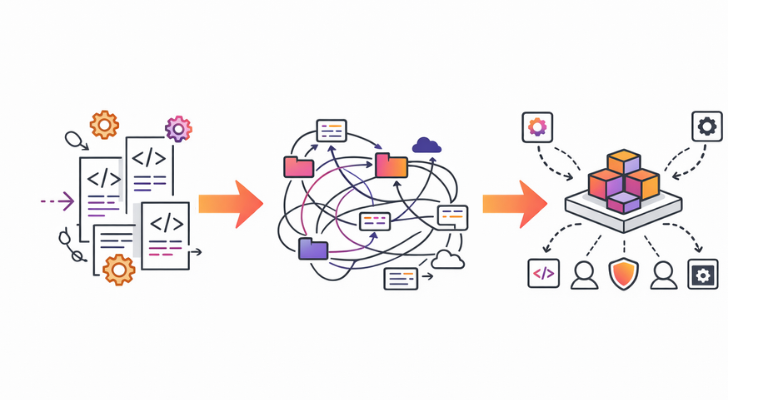
At some point, automation stops being a collection of solutions and becomes a landscape.
Scripts exist across servers, admin machines, scheduled tasks, and shared folders. Some are documented, some are not. Some are maintained, others are “just working”.
Different execution contexts emerge naturally. Different permissions. Different assumptions.
Everything still works.
But nothing is truly controlled.
That is the moment where automation looks mature from the outside, but internally starts to drift.
Why the Code Is Not the Weak Point
The script itself is almost never the issue.
A well written PowerShell script is precise, deterministic, and predictable. It does exactly what it is supposed to do. No more, no less.
The problem begins the moment that script leaves isolation.
Because a script does not just execute logic. It executes within a context.
And that context defines everything that matters in enterprise IT.
Who runs it.
With which permissions.
Against which systems.
With which credentials.
If those variables are not controlled, the script is only technically correct, not operationally safe.
The Hidden Weakness: Execution
In many environments, execution is not designed.
It is inherited.
A user runs a script.
The script runs with that user’s permissions.
The environment defines the rest.
This feels efficient because it removes friction.
But it introduces something far more dangerous.
Unpredictability.
Because execution becomes dependent on who runs the script, where it is run, and under which conditions. Two identical scripts can produce different outcomes simply because the execution context is different.
That is not automation.
That is controlled coincidence.
The Tipping Point
This model works until the environment grows.
More systems, more users, more integrations, more dependencies.
Then new requirements appear.
Tasks must be delegated.
Credentials must be rotated.
Actions must be traceable.
Access must be restricted.
And suddenly, the existing automation model starts to break under its own weight.
Not because the scripts fail.
But because the system around them cannot support them anymore.
Why Traditional Approaches Fall Short
Most teams respond in predictable ways.
They improve documentation.
They centralize scripts.
They introduce naming conventions.
They run trainings.
All of this helps, but none of it solves the core issue.
Because the problem is not visibility.
It is not knowledge.
It is not discipline.
The problem is that execution itself is not defined as part of the system.
As long as execution is implicit, everything built on top of it remains fragile.
The Real Turning Point: Controlling Execution
The real shift happens when execution becomes a first-class concern.
Not something that happens after a script is written, but something that is defined before it is ever used.
What changes when a user no longer executes a script directly, but only triggers an action
What changes when permissions are no longer attached to people, but to controlled execution contexts
Everything changes.
Execution becomes consistent.
Independent of the user.
Independent of the machine.
Independent of local conditions.
For the first time, automation becomes predictable at scale.
Where ScriptRunner Comes In
This is exactly where ScriptRunner operates.
Not at the script level, but at the execution level.
A user no longer runs a script.
A user triggers an action.
ScriptRunner takes over from that moment.
Execution happens in a defined context.
Credentials are centrally managed and never exposed.
Permissions are enforced through roles, not through direct system access.
The script remains what it always was.
But its execution is no longer left to chance.
What Actually Changes in Practice
The impact is not theoretical.
It shows up immediately in daily operations.
Tasks that used to require escalation are handled directly.
Helpdesk teams perform actions without needing elevated access.
Administrators stop executing and start designing systems.
Processes become repeatable.
Outcomes become predictable.
Dependencies on individual knowledge start to disappear.
Automation is no longer something that exists in the background.
It becomes part of how the system operates.
The Difference Between Existence and Scale
Most environments have automation.
Few environments have automation that scales.
The difference is not in the number of scripts or the quality of code.
It is in the control over execution.
Automation that exists solves isolated problems.
Automation that is controlled becomes part of the operating model.
That is where real value is created.
Conclusion: The Future Is Defined by Execution
The next evolution of IT will not be driven by more scripts.
It will be driven by systems that control how automation is executed.
Everything that follows, whether it is advanced orchestration, AI driven processes, or autonomous operations, depends on this foundation.
Without controlled execution, automation becomes risk.
With it, automation becomes infrastructure.
ScriptRunner provides exactly this layer.
Not by changing what scripts do,
but by defining how they are allowed to run.
And that is the difference between automation that works today,
and automation that will still work tomorrow.
See what controlled execution looks like in practice. Book a meeting with our team.