.svg)

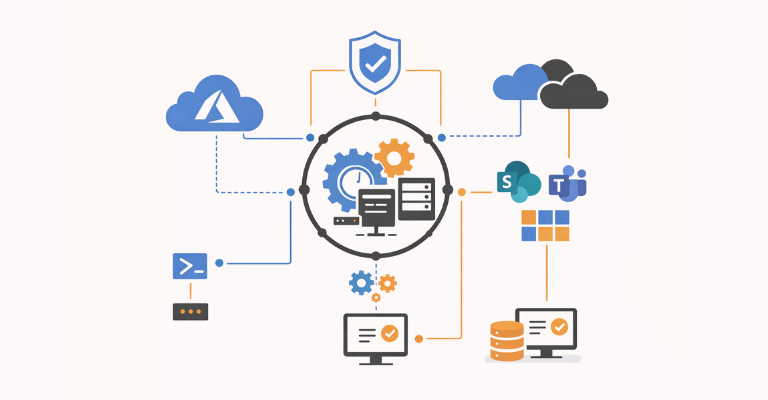

If automation triggers define when automation runs, and the automation and orchestration engine defines how it runs, then automated systems are the end goal, where automation delivers tangible, measurable value. It is at this stage that workflows interact directly with live infrastructure, apply changes, and perform operational tasks that were previously handled manually.
Modern enterprises operate across a complex technology landscape, including cloud platforms, SaaS applications, identity providers, endpoints, hybrid data centers, and legacy systems. Without a unified automation platform, each environment often gives rise to its own scripts, tools, and operational shortcuts. Over time, this results in fragmented automation practices, duplicated effort, inconsistent security controls, and limited overall visibility.
By contrast, a centralized PowerShell automation platform such as ScriptRunner enables these disparate systems to operate within a shared execution and governance model. Automation becomes consistent, auditable, and scalable, regardless of where it runs or what triggers it.
Below are examples of systems where automation acts as a key productivity enabler, and how centralization helps amplify its benefits while reducing its risk.
Self-Service Automation: Scalable Productivity Without Privilege Sprawl
One of the fastest ways organizations realize value from automation is by making approved automated actions available to a broader set of users wherever delegation is appropriate.
This is particularly effective in environments where IT teams are burdened with high volumes of repetitive, low-risk requests, such as password resets, group membership changes, mailbox updates, access requests, and other user lifecycle activities. These tasks are commonly delegated to support teams to free senior administrators to focus on higher-impact initiatives.
Such tasks are also well suited to automation, where support staff can execute them faster, more consistently, and with fewer errors. However, concerns around security, permissions, and accountability often prevent this. Because deploying automation scripts requires elevated privileges or technical expertise, less technical staff are left to perform tasks manually. The result is slower service delivery and increased operational overhead as additional staff are needed to manage demand.
ScriptRunner addresses this challenge by enabling teams to publish pre-approved automation workflows through controlled self-service interfaces. Users can initiate actions via portals, embedded widgets, or integrated service platforms, without being granted elevated permissions.
Crucially, every execution still runs through the central automation engine, with role-based access controls, approval workflows, execution policies, and comprehensive logging enforced by default. Users achieve fast, reliable results, while IT retains full visibility and control over what runs, how it runs, and under which security policies.
This approach not only improves service delivery today, but also lays the groundwork for future agentic automation. When AI agents begin triggering actions autonomously, they will rely on the same governed, validated workflows that ensure safe delegation to human users.
Cloud Automation: Governing Scale Across Azure and Microsoft 365
Cloud platforms, whether public, private, or hybrid, deliver speed and flexibility, but they also introduce constant change. Azure resources evolve, Microsoft 365 tenants grow and contract, and configuration drift becomes inevitable without a structured automation approach designed to manage this dynamism.
ScriptRunner provides a centralized execution layer for cloud automation, enabling IT teams to standardize and govern tasks such as:
- User provisioning and deprovisioning.
- License assignment and optimization.
- Azure resource deployment and lifecycle management.
- Microsoft Teams and SharePoint provisioning.
- Policy enforcement and compliance checks.
- ...and many more.
Instead of individual teams maintaining their own scripts that quickly become outdated, automation assets are shared, version-controlled, and executed consistently across the organization. Governance, logging, and approval mechanisms are applied uniformly, regardless of whether automation is triggered manually, on a schedule, by an event, or by an AI agent.
This level of consistency is essential not only for managing today’s cloud automation at scale, but also for ensuring that future agentic automation initiatives can operate safely, predictably, and in line with compliance requirements.
Data Center and Hybrid Automation: Modern Control for Legacy Systems
Despite widespread cloud adoption, most enterprises continue to rely heavily on on-premises and hybrid systems. Platforms that span both local and cloud environments, such as Active Directory, file servers, databases, virtual machines, and line-of-business applications, are often the most operationally complex to manage.
Historically, these environments have been automated using locally maintained scripts, scheduled tasks, and team-specific tooling. Over time, and without centralized oversight, this approach leads to operational silos, increased risk, and limited integration across hybrid environments.
By centralizing execution through ScriptRunner, organizations can bring structure and control to these systems. Tasks such as patching, certificate management, backup orchestration, server maintenance, and configuration management are executed through a single, governed automation engine. This reduces manual effort, improves consistency, and helps ensure that legacy systems remain secure and compliant, regardless of who triggers the automation or where it runs.
As agentic automation continues to expand, this foundation becomes even more critical. When execution logic is standardized and centrally governed, AI-driven workflows can safely orchestrate actions across on-premises infrastructure while seamlessly integrating with cloud-based systems and services.
Infrastructure and Endpoint Automation: Consistency at Scale
Endpoints, networks, and device environments require a constant stream of operational activity, including policy enforcement, configuration changes, remediation actions, and compliance checks. These activities are well suited to automation, but only when execution is well governed and fully traceable.
ScriptRunner ensures that infrastructure and endpoint automations operate within the same governance framework as all other workflows. Regardless of whether an action is initiated by a human user, a scheduled task, or an automated agent, execution follows consistent policies for identity, credential handling, approvals, and logging.
This consistency creates a continuous feedback loop in which comprehensive operational data is centralized and easily accessible. Over time, this visibility strengthens security posture, improves reliability, and drives greater operational efficiency.
With this foundation in place, agentic automation can assume a more proactive role in evaluating signals, detecting issues, and triggering remediation automatically without introducing uncontrolled behavior across the environment.
The Common Thread: Centralized Execution as the Foundation for Future Readiness
Across local, cloud, and hybrid infrastructure automation, a consistent pattern emerges: automation is only as reliable as the platform that governs it. Fragmented execution leads to fragmented outcomes, while centralized execution and orchestration enables automation that is predictable, scalable, and auditable.
Throughout this four-part series, we’ve shown that modern enterprise automation is not defined by individual scripts or isolated tools, but by a cohesive operating model:
- Triggers define when automation runs.
- The automation engine defines how it runs.
- Automated systems define where value is created.
By bringing all automated systems under a single automation platform with shared policy enforcement, identity controls, and performance tracking, organizations establish the stability and consistency that advanced automation approaches depend on.
ScriptRunner unifies these three dimensions under a single, governed automation and orchestration platform for Microsoft ecosystems. It enables organizations to scale automation safely, deliver measurable productivity gains today, and lay the technical foundations required for agentic automation in the future.
If you’re ready to move from fragmented automation to a unified, enterprise-grade automation strategy, book a meeting with ScriptRunner to see how it works in practice.