.svg)
.svg)

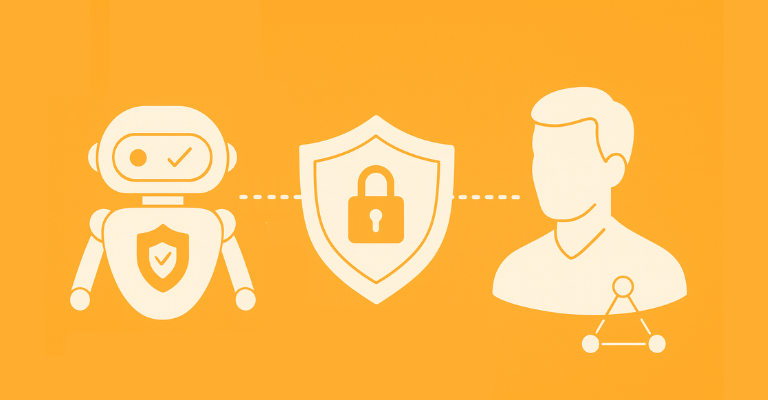
Over the past year, enterprises have rapidly accelerated their adoption of agentic automation, allowing AI agents to take actions, execute workflows, and interact with business systems autonomously.
But as adoption grows, so does a problem that many IT leaders are quietly struggling with: uncontrolled access.
Security researchers consistently identify poor access governance as one of the biggest contributors to breaches. AI adoption is amplifying this trend, not reducing it.
Why? Because each AI agent that an organization spins up adds an identity that can be exploited by malicious actors to access tools and databases within the company infrastructure.
AI agents behave like digital employees: they log in, interact with APIs, read and write data, and execute scripts. Yet the safeguards that govern human users, such as the principles of least privilege, role-based access control (RBAC), and zero-trust, are often ignored when dealing with AI identities. This results in an expanding surface of high-privilege, minimally governed accounts ripe for misuse and misconfiguration.
Before agentic automation becomes deeply embedded into business processes, access governance must evolve to consistently treat AI agents with the same rigor as human identities. Otherwise, organizations face a future where autonomous agents operate with more freedom and less accountability than any human administrator would ever be granted.
Machine Identity vs. Human Identity: What’s the Difference?
Enterprises have spent decades refining identity governance for human users. When a new employee joins, no responsible IT leader would simply hand them unrestricted access to critical systems, sensitive customer data, and high-risk administrative tools without qualification. Instead, onboarding follows a well-defined model:
- Assign a role
- Map permissions to that role
- Apply least-privilege access
- Enforce zero-trust principles
- Monitor activity continuously
This is now standard practice. Yet AI agents, despite having similar or even greater levels of operational capability, are frequently exempt from these controls.
AI agents are not benign. They can:
- Execute scripts
- Modify configurations
- Query databases
- Trigger workflows
- Access APIs across cloud and on-premises systems
In other words: they can do everything a privileged human user can do, and often much faster.
If an AI agent is misconfigured or hijacked, the consequences can be catastrophic: unauthorized data access, cascading errors, privilege escalation, and operational outages that IT must scramble to untangle.
Worryingly, organizations are spinning up AI agents as quickly as they once created test accounts, granting them broad permissions “just for testing” and leaving those identities lingering with more privilege than any single user should have.
Treating AI agents like “non-users” is a misunderstanding of what agentic automation actually is. If an agent has the ability to make changes inside your Microsoft ecosystem, it must be governed like a human identity, with the same rigor, the same oversight, and the same enforcement of policy.
Agentic automation cannot mature safely until machine identities are treated with the same seriousness as human ones.
How to Enforce Access Governance for AI Agent Identities
Getting access governance right isn’t just a security requirement; it’s a foundational enabler of reliable, scalable agentic automation that integrates deeply into business processes and generates long-term ROI. When AI agents know exactly what they’re allowed to do and IT has full visibility into how they operate, organizations can finally trust these systems to run autonomously.
Here’s how to build an access governance model that safely supports agentic automation:
1. Define Clear Roles and Permissions for Each Agent
Every AI agent must have a defined purpose. Before assigning any permissions, IT should ask:
- What is this agent supposed to do?
- What systems does it need to interact with?
- What tasks is it responsible for executing?
- Where should its privilege end?
If an agent’s role is user provisioning, it shouldn’t have rights to modify SharePoint structures or access finance databases. If its job is ticket triage, it shouldn’t have the ability to reconfigure endpoints.
A well-defined role prevents scope creep, accidental privilege escalation, and unintended access paths.
2. Fence Off Everything Outside the Approved Scope
Once an agent’s role is defined, every resource, action, and API outside that scope should be explicitly blocked.
This includes:
- Restricting access to sensitive data collections
- Denying use of administrative privileges
- Preventing cross-tenant or cross-environment access
- Applying conditional access and network restrictions
- Validating every action against policy
Segmentation and containment are essential. AI agents should operate inside controlled guardrails with no capacity to wander into unapproved systems or datasets.
3. Establish Central Oversight Across All Agent Identities
Agentic automation will only scale safely if organizations can monitor, audit, and control all AI identities through a single governance layer.
Central oversight ensures:
- Complete visibility of all agents and their roles
- Consistent approval processes
- Unified RBAC policy enforcement
- Consolidated logging and audit history
- The ability to trace every action back to a specific agent identity
This central control plane must act as the policy gatekeeper across Azure, Microsoft 365, Teams, Intune, SharePoint, and all PowerShell-driven workflows. Without it, AI agents become scattered, opaque, and inconsistent, creating the conditions that lead to operational failures and security incidents.
4. Standardize and Automate Agent Provisioning
If AI adoption continues at its current pace, companies could soon have hundreds of agent identities operating across their Microsoft environments. Provisioning and configuring these identities manually is simply not sustainable.
Instead, agent identity management must be automated with:
- Standard role templates
- Pre-approved permission sets
- Centralized execution policies
- Mandatory logging and script-signing
- Consistent onboarding and offboarding processes
The more standardized agent provisioning becomes, the easier it is to enforce governance and maintain compliance as adoption scales.
ScriptRunner Helps You Bring AI Access Governance Under Control
Agentic automation has the potential to revolutionize business productivity, but only if the underlying access governance model is strong enough to prevent chaos and risk.
ScriptRunner provides the centralized automation platform enterprises need to:
- Govern AI agent identities with the same rigor as human identities
- Enforce RBAC, conditional access, and least-privilege principles across all automations
- Standardize provisioning and policy enforcement for every agent
- Maintain complete visibility through unified logging, auditing, and execution oversight
- Run secure, policy-aligned, and compliant automations across the entire Microsoft ecosystem
If your automation strategy is preparing for agentic automation, your access governance must evolve first. With ScriptRunner, organizations gain the guardrails required to deploy agentic automation safely, scale it sustainably, and unlock real productivity without exposing themselves to unnecessary risk.
Book a meeting and start building the secure foundation that future-proof AI operations require.