.svg)
.svg)

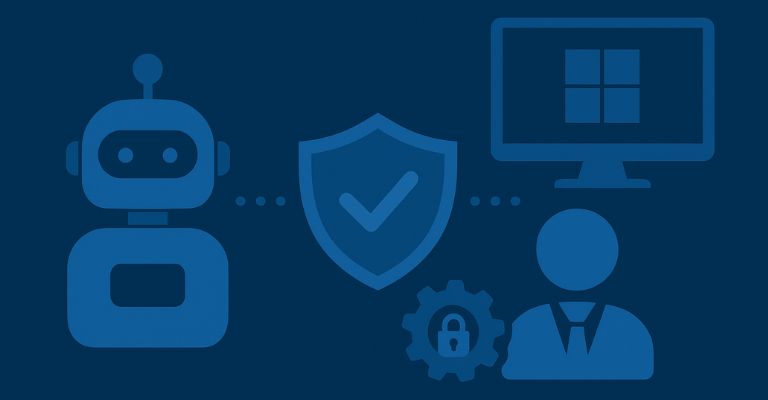
In a world where budgets are tightening and every employee hour counts, IT leaders are looking towards agentic automation for higher efficiency.
In particular, there are huge productivity gains to be sought in slashing time spent on routine tasks and unleashing human talent to work on higher-impact projects.
When integrated with scripting frameworks like PowerShell, agentic automation can take work off human hands, helping to deliver projects faster and scale operations without growing headcount.
Yet despite the promise, general statistics on AI usage within enterprise are disappointing:
- A recent MIT report found that 95% of AI pilots at companies fail to generate any return on investment.
- According to RAND Corporation, over 80% of AI projects fail, double the failure rate of non-AI IT efforts.
- S&P Global shows that 42% of companies scrapped most of their AI initiatives in 2025.
What’s the story behind these numbers?
The answer is this: amidst the current AI hype, capabilities are constantly developing, and knowledge on what can be done using agentic automation is fragmented. Combine this with FOMO, and many IT teams are rushing to adopt AI capabilities without clear strategic foresight or effective guardrails.
The results of poorly deployed AI tools can be chaotic and costly to clean up: automation workflows that are hard to keep track of, AI-generated scripts that drift from requirements, and mismanagement of access controls that opens security gaps.
Such problems cause teams to cut their losses and scrap projects before they get out of hand.
Why Lack of Guardrails Causes Agentic Automation to Fail
AI agents can learn, generate, and execute PowerShell scripts faster than any human.
Soon, if all goes to plan, AI agents should be writing scripts, resolving tickets, and orchestrating complex workflows autonomously.
But without effective guardrails to keep them on-task, issues such as script sprawl, untraceable decision-making, and data leaks cause AI agents to become ungovernable.
In addition to this, many governments are imposing new regulations which place costly penalties on poorly implemented AI-driven systems that do not comply with rules on processing sensitive data.
These are potential ROI-killers that need to be addressed before agentic automation can become an established part of enterprise-grade operations.
To realize long-term value, organizations need to do more than just put AI capability into the hands of employees quickly; they need guardrails for their AI deployments, framed within a robust governance framework, to ensure that this capability is working securely, synergistically, and productively in the long-term.
Well-designed guardrails for agentic automation should ensure:
- Structured integration into existing workflows, producing tangible productivity benefits.
- Strict prompting and delimitations so that each AI Agent works within clear boundaries.
- Traceability and documentation for effective debugging when things go wrong.
- Governance and auditability for every automation activity to stay compliant with regulations.
Many teams can attest to the lack of these guardrails in their adoption of AI throughout 2025.
With them, agentic automation can become what it promises to be: a faster, smarter way to automate enterprise tasks that secures ROI not just on pure technical delivery but also on the people delivering it.
A Practical 5-Step Method for Implementing Agentic Automation Into Microsoft Ecosystems
To build agentic automation into their Microsoft automation strategy effectively, teams follow a structured, incremental approach that builds guardrails into every step.
Here is our practical 5-step framework for uncovering efficiencies through agentic automation without losing control:
1. Identify Incremental Productivity Gains
Start small and focused. Look for repetitive, low-risk PowerShell tasks that AI agents can take over and perform faster than humans would, without overstretching their capabilities. This could include parsing, system health checks, report generation, user account audits, or backup verification.
Incremental time-saving wins will compound and build confidence in agentic automation without overexposing your infrastructure.
2. Define Inputs, Outputs, and Expectations
Before deploying an AI agent on any task, be clear on how it receives information (user prompts, triggers, datasets), what it should produce (defined actions and outcomes), and what quality standards apply (compliance requirements and SLAs).
This ensures smooth, trackable automation that sticks to its assigned tasks and avoids hallucinations.
3. Equip Agents With the Right Tools, and Only Those
The power of AI agents is their ability to use the same tools that humans do. Provide them with controlled PowerShell environments, approved modules, and secure API integrations so that they can take over tasks within your existing workflows.
However, always make sure to put defined limits in place. Configure tools so that AI agents only have access to the functionality needed for their assigned task, and deploy in test environments first, to catch misalignment before it enters production.
4. Implement Rigorous Controls and Permissions Around Sensitive Data
This is where governance becomes critical. Treat AI agents like human identities, assigning clear roles, credentials, and execution boundaries for every AI agent according to standard zero-trust principles.
Combine script signing, human-in-the-loop checkpoints, and conditional access policies to prevent deviation from requirements or accidental data leaks.
5. Track, Log, and Document Everything
Before rolling out AI-driven automations, make sure that execution logs are set up to track prompts, inputs, actions, and outcomes at every step throughout their lifecycle. Policy, governance, and documentation are not afterthoughts, they’re the blueprint for scaling your agentic automation strategy safely and ensuring long-term ROI.
Be mindful that when dealing with sensitive data, transparency in all AI-driven activity is necessary to pass compliance audits and ensure the long-term viability of your system.
Following these steps enables organizations to move from chaotic experimentation to controlled innovation that scales.
Over time, teams will gain the confidence to let AI agents take over more routine tasks, producing compounding ROI as part of a robust agentic automation system.
How ScriptRunner Will Enable Enterprise-Grade Agentic Automation
Building guardrails into your agentic automation manually can be complex. That’s where ScriptRunner comes in.
ScriptRunner’s centralized automation platform already provides the guardrails needed to build high-efficiency Microsoft automation strategies, laying the foundation for governance in the AI-driven era:
- Built-in governance and policy enforcement: Every identity and script execution is subject to clearly defined permissions and access controls.
- Fully centralized oversight and control: Real-time dashboards let you monitor AI-driven PowerShell automations as they run.
- Advanced debugging and error handling: Comprehensive logging enables quick troubleshooting and remediation when errors occur.
- Auditability and compliance: Every automation activity is documented, versioned, and fully auditable in compliance with ISO 27001, SOC 2, and other enterprise frameworks.
- Team empowerment: Administrators deploy automations confidently and precisely, freeing up time for more significant work.
Check out how ScriptRunner helped teams save over 4,000 hours on routine tasks at Brose, or empower employees at Rhenus Logistics to focus their time on high-impact projects.
As AI becomes more embedded into Microsoft ecosystems, traditional PowerShell scripting will evolve into zero-touch agentic automation, where AI agents are able to respond to triggers and execute scripts to solve problems autonomously.
ScriptRunner doesn’t just make this easier, it makes it governable, sustainable, and investible.
By combining AI’s creative power with ScriptRunner’s established functionality, IT teams will achieve another level of operational efficiency:
- Maximum ROI from AI-driven automations
- Enterprise-grade consistency and resilience
- Transparent, auditable, centralized operations
- Scaling productivity without scaling headcount
Empower your teams to harness enterprise-grade agentic automation with confidence. Start your free trial today.