.svg)
.svg)

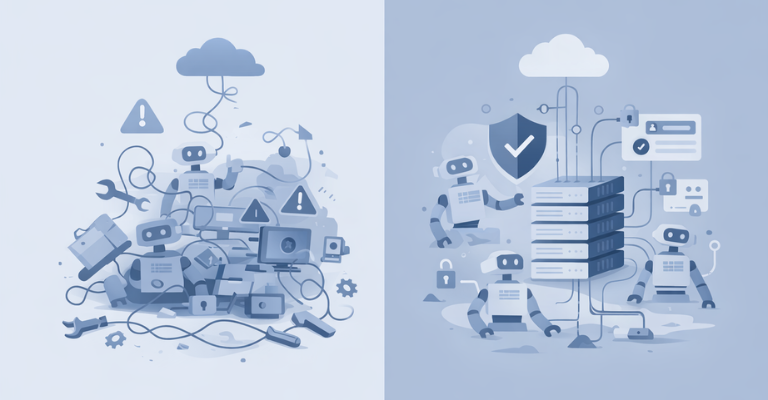
IT teams under pressure to do more with fewer resources feel compelled to operationalize agentic automation for its transformative potential. Autonomous agents can reason over context, make decisions, and execute multi-step workflows across systems with minimal human intervention. The hope is that this enables routine operational work to be completed faster and more consistently, freeing skilled teams to focus on higher-value initiatives.
Early experiments often reinforce that optimism. In controlled environments, AI agents can provision users, remediate configuration drift, and resolve service requests faster than any human. This creates the impression that large-scale autonomy is within easy reach.
However, many organizations are now discovering that success in a sandbox does not equate to operational readiness. When agentic automation moves beyond pilots and into live environments, hidden weaknesses emerge. Under the load of real conditions, teams find that reliability disappears, security concerns escalate, and confidence erodes. Instead of accelerating delivery, automation becomes another source of risk that frustratingly demands increased oversight.
This article explores why DIY approaches to agentic automation break down at scale, and why a centralized execution platform is the key to turning agentic workflows into a dependable, enterprise-grade capability.
The DIY Trap: Why Agentic Automation Starts Strong but Fails to Scale
Most agentic automation initiatives begin with teams experimenting independently. For example, one group builds agents around PowerShell scripts, another uses cloud functions, a third layers AI copilots onto existing RPA workflows. Each solution is tailored to local needs and works well enough in isolation.
The problem is that these efforts rarely converge into a cohesive system.
Over time, organizations accumulate:
- Multiple, incompatible execution models
- Divergent approaches to credential management and permissions
- Inconsistent logging, monitoring, and error handling
- Critical knowledge locked up in individual teams or engineers
What initially feels like speed and innovation soon becomes a source of operational fragility. Changes in one environment break workflows elsewhere; troubleshooting becomes increasingly complex; lacking central oversight, no one can say with certainty how many agents exist, what data they can access, or how they’re configured to behave under edge conditions.
Without a strong, centralized backbone to govern automation executions, scaling DIY agentic automation further feels too risky to justify. Potential costs outweigh the gains, and promising initiatives stall before they can deliver enterprise-wide impact. If, as Gartner predicts, over 40% of agentic AI projects will be canceled by 2027, this is why.
Agentic Automation Isn’t Just a New Tool; It’s a New Operating Model
Agentic automation is fundamentally different to traditional automation. Rather than merely executing a predefined sequence of steps, AI agents can interpret context, make decisions, and dynamically chain actions together in response to changing requirements.
This level of autonomy and flexibility introduces the need for a whole new operating model.
To deliver consistent, dependable results at scale, agentic systems require:
- Predictable execution surfaces
- Clearly defined authority boundaries and guardrails
- Full traceability and accountability
- Governance controls that scale with autonomy rather than constraining it
DIY approaches to agentic automation rarely meet these requirements. Instead, they treat AI agents simply as “smarter tools” layered onto existing systems, without adapting their approach to the specific needs of agentic behavior.
Without a purpose-built operating model designed for agentic automation, its innate autonomy and flexibility become a risk that are unsuitable for production environments affecting live infrastructure and sensitive data.
The Dangers of Deploying DIY Agentic Automation in Production Environments
Credential Chaos
In many DIY automation implementations, credentials are inadvisably hard coded into scripts, stored in environment variables, or embedded directly into prompt logic. On top of this, access scopes are often overly broad, credential rotation is manual, and ownership is poorly documented.
Transferring this approach onto agentic systems that operate autonomously, it becomes nearly impossible to determine who or what accessed a system, when, and under which authorization. From a security standpoint, this creates an unacceptable attack surface and significantly increases the potential impact of any compromise.
Approval and Control Gaps
Without sufficient oversight, agents are frequently configured to react to real-time conditions and execute actions immediately, with no way to distinguish between low-risk routine actions and high-impact changes that should require review or escalation.
The absence of structured approvals, risk-based controls, or human-in-the-loop mechanisms exposes organizations to unnecessary operational and compliance risk. On the other hand, overly stringent checks limit autonomy and flexibility too much for agentic automation to deliver meaningful value. A structured balance must be reached, which only a centralized approach deliberately designed for agentic automation can provide.
No Single Source of Truth
In fragmented DIY environments, execution logs are scattered across AI tools, cloud services, scripts, and local machines. When something goes wrong, reconstructing what happened becomes a forensic exercise involving multiple teams and incomplete data sets.
This lack of unified observability slows incident response, makes root-cause analysis unreliable, and erodes trust in agentic automation as a whole.
Operational Drift
As teams independently update prompts, permissions, and execution logic, agent behavior begins to diverge. Small inconsistencies compound over time, resulting in unpredictable outcomes across organizational infrastructure.
Rather than reducing workload, this increases manual remediation efforts and undermines confidence in automation as a reliable operational capability.
Operationalizing Agentic Automation Requires Treating It Like Enterprise Infrastructure, not a DIY Tool
High-efficiency enterprises don’t run production infrastructure by allowing every team to manage servers, credentials, and access policies independently. They centralize execution, standardize controls, and enforce policy through shared platforms designed for scale, security, and accountability.
Agentic automation should be no different.
Operationalizing agentic automation correctly means:
- A single execution layer, not fragmented runtimes
- Consistent identity and access enforcement
- Standardized policies applied everywhere
- Visibility by default, not by exception
DIY approaches optimize for short-term speed, but break under real-world conditions. Central platforms optimize for sustainability, safety, and scale so that real business impact and ROI can be achieved in the long term. That’s why platforms consistently outperform custom-built solutions once agentic automation moves beyond experimentation.
A centralized execution platform enables what a DIY approach can’t:
A Controlled Execution Layer
In a centralized model, every agent-initiated action runs through the same governed execution surface. Regardless of which team, tool, or AI agent initiates the request, execution behavior remains consistent and dependable.
This makes automation predictable and effective at scale.
Credential Vaulting and Identity Enforcement
Central platforms eliminate the need for hardcoded secrets by integrating secure credential vaults and identity controls. Agents are granted only the permissions they require, for the minimum duration necessary, and strictly within predefined security policies.
This preserves strong security postures while allowing teams to innovate at pace.
Built-In Approval and Risk Controls
A centralized execution platform enables autonomy to be balanced with oversight. High-impact or sensitive actions can trigger approvals, conditional checks, or additional validation, while low-risk, routine tasks run fully autonomously.
This risk-aware model allows agentic automation to scale without compromising safety or compliance.
Unified Monitoring and Observability
All executions, whether initiated by humans or AI agents, are logged and monitored in a single system of record. Teams gain real-time visibility into performance and usage patterns across the organization.
This accelerates troubleshooting, simplifies audits, builds trust in automation increases, and enables continuous optimization through a comprehensive feedback loop.
ScriptRunner: Turning Agentic Automation into an Operational Asset
At this stage of development, agentic automation rarely fails because of limitations in AI models. It fails when organizations attempt to scale autonomous behavior on top of fragmented, DIY execution environments that were never designed for enterprise control, security, or efficiency.
ScriptRunner provides the execution backbone that agentic automation requires to operate safely, predictably, and at scale within Microsoft ecosystems.
With ScriptRunner:
- All execution, permission management, credential assignment, and logging is centralized within a single, governed automation platform.
- AI agents interacting with operational systems are always subject to policy-driven access controls, approvals, and guardrails.
- Teams access agentic workflows through a trusted automation layer, enabling innovation and speed while preserving enterprise-grade control and oversight.
If you’re ready to operationalize agentic automation with confidence, book a meeting with ScriptRunner today.