.svg)
.svg)

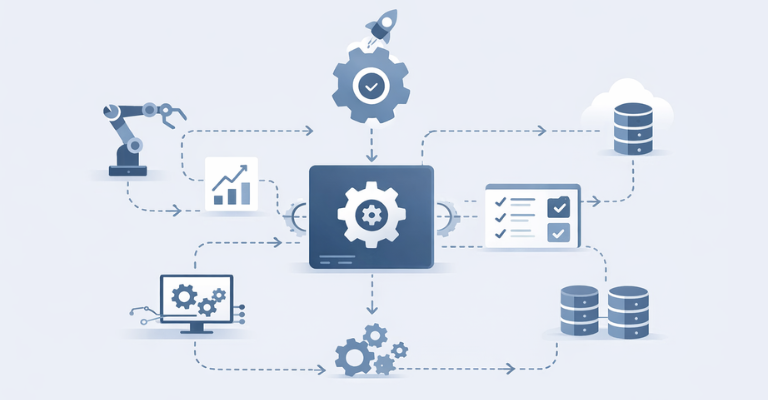
Agentic automation has rapidly progressed from concept to integration. AI agents can now be embedded directly into enterprise IT automation environments, where they reason, plan, decide, and even explain their actions autonomously. This elevates enterprise automation beyond static workflows and predefined logic toward fully closed-loop, self-driving systems.
However, when organizations attempt to deploy these capabilities in production environments, many initiatives struggle to move beyond experimentation. McKinsey reports that while 88% of enterprises use AI in at least one business function, only about 23% are scaling agentic AI systems beyond initial pilots.
The common problem is that agentic automation initiatives fail to turn autonomous decision-making into real-world outcomes that deliver sustained ROI.
At the core of this challenge, we suggest, isn’t a lack of reasoning or execution capability within agentic systems themselves. Rather, it’s the absence of a dedicated orchestration strategy. This is a factor that is frequently overlooked during experimentation and early deployments. Without this, agents operate as isolated task performers instead of coordinated components within a broader, enterprise-grade automation architecture.
Agentic Automation Promises Autonomy, Enterprises Require Outcomes
The appeal of agentic automation is straightforward. Conceptually, it represents the natural evolution beyond scripted workflows. Instead of predefining every possible path, agents can respond dynamically to real-world triggers and take autonomous action based on context, goals, and changing conditions. In theory, this level of system autonomy promises faster response times, reduced manual effort, and improved operational resilience.
Enterprise environments, however, are unforgiving. The margin for error is small, particularly when designing technical systems, such as agentic automation, to operate continuously without direct human intervention.
Production systems function under strict constraints: security policies, compliance requirements, change controls, and complex interdependencies across platforms. In this context, automation must be predictable, auditable, and resilient. Partial success or intermittent failure is rarely acceptable. As a result, agentic automation must demonstrate consistent, secure performance over time before it can move beyond pilot programs and be integrated into live production environments.
This is where many agentic automation initiatives encounter friction. While agents often perform well in isolated or controlled settings, issues arise once they are introduced into operational systems with greater complexity and interconnection. Common symptoms include:
- Fragile integrations that perform well in carefully designed test scenarios but fail under real-world conditions.
- Inconsistent execution across environments, including occasional nonsensical or “hallucinated” outputs.
- Limited visibility into failures or decision paths, making troubleshooting, optimization, and auditing difficult.
- Increased manual oversight required to compensate for this inconsistency, ultimately reducing productivity compared to traditional, script-based automation.
The result is that many promising pilots fail to mature into dependable, enterprise-grade operations. Teams are either unwilling to absorb the operational overhead these issues create or are prevented from progressing by regulatory and governance constraints. This challenge is both fundamental and widespread in the operationalization of agentic systems.
The Execution Gap Between Agent Decisions and Real Systems
A closer examination of most agentic automation architectures, particularly at the experimentation and early integration stages, reveals a critical gap between agentic decision-making capabilities and real-world execution requirements.
Many organizations bring fragmented legacy automation practices forward into their agentic initiatives. As a result, while individual agents may be thoughtfully designed, the broader execution environment in which those agents are expected to operate is often under-engineered.
Much of the effort in early agentic automation focuses on the agent itself: prompt design, tool integrations, credentials, and permissions. Far less attention is given to system-level concerns, such as how agents are supposed to coordinate actions over time, and interact reliably with complex production environments as they evolve.
This overlooked architectural layer is responsible for some of the most operationally significant aspects of automation, including:
- Coordinating multi-step actions across systems.
- Handling errors, retries, and partial failures.
- Managing overall system health and performance metrics over time.
- Enforcing approvals, guardrails, and organizational policies.
- Ensuring end-to-end observability and auditability as automated actions span multiple tools and platforms.
Its importance therefore cannot be overstated.
When these responsibilities are left to individual agent logic or to ad-hoc tooling assembled by distributed teams, reliability inevitably degrades. Failures become more difficult to detect and resolve, security and compliance controls are applied inconsistently, and trust in agentic systems erodes. Over time, teams are forced to revert to manual processes or restrict automation to low-risk use cases, significantly limiting its impact.
In enterprise environments, this execution and orchestration gap is often the decisive factor between mere experimentation and sustained, organization-wide value.
Orchestration Is What Turns Agent Decisions into Real Automation
Centralizing the execution and orchestration layer, with a focus on deliberately designing the environment in which agentic systems operate, is a critical step toward achieving structured, reliable, and consistently valuable agentic automation. This approach creates the conditions in which agents can perform effectively, and teams can confidently operationalize their capabilities.
In practical terms, a centralized orchestration mechanism ensures that decisions made by agents are executed in a controlled and repeatable manner, regardless of who builds the agents or where they act. It coordinates actions across systems, maintains state, manages exceptions, and enforces governance, while providing clear visibility into what is happening and why.
Treating orchestration as a first-class architectural component and intentionally building infrastructure that supports agentic autonomy allows each part of the system to focus on its strengths:
- Agents concentrate on intent, analysis, and decision-making, autonomously executing routine tasks across tools and systems.
- A centralized execution and orchestration engine ensures execution remains reliable, observable, and compliant across all systems.
The impact is tangible. Automation becomes more resilient, easier to scale, and easier to trust. Most importantly, it begins to deliver consistent, repeatable outcomes rather than isolated successes.
Why ScriptRunner Is the Backbone Agentic Automation Needs
ScriptRunner is purpose-built to address execution and orchestration challenges in large-scale automation.
Rather than embedding execution logic directly into individual agents, ScriptRunner provides a centralized orchestration layer designed for enterprise environments. It ensures that when an agent determines an action should occur, that action is executed securely, consistently, and in accordance with organizational policies and controls.
In this model, agentic systems and ScriptRunner operate in clearly defined, complementary roles:
- Agents determine what should be done and when.
- ScriptRunner governs how those actions are executed across real systems.
This separation allows organizations to scale agentic automation without compromising reliability, security, or control. Automation initiatives are no longer limited by fragile integrations or opaque execution paths. Instead, they are underpinned by a robust execution foundation aligned with enterprise operational standards.
Agentic automation does not fall short because agents lack capability. It falls short when the operational environment is not designed to support autonomous action.
Organizations seeking to realize measurable ROI from agentic automation must treat orchestration as a core architectural concern. With ScriptRunner as the execution backbone, AI-driven decisions can move beyond experimentation and become dependable, enterprise-grade outcomes.
To explore how a centralized execution and orchestration layer can help your organization operationalize agentic automation and achieve real-world results, book a meeting today.