.svg)
.svg)

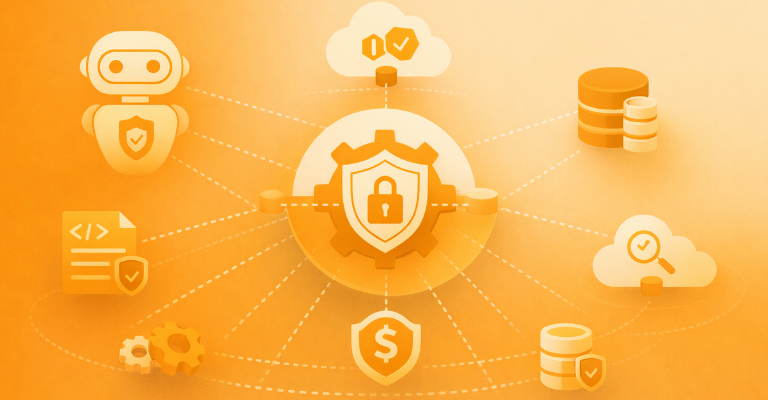
The last 18 months have seen explosive investment in AI and automation across virtually every industry. Teams rushed to adopt new tools and embed agentic models into daily work. Yet despite this momentum, many organizations are quietly admitting that the expected return on investment isn’t materializing, with only 23% of organizations scaling agentic automation beyond pilot stages.
As we’ve covered in previous articles, the problem isn’t the AI models themselves; it’s the environment they’re being asked to operate in.
In most enterprises, automation is spread across dozens of disconnected systems, each with its own data structures, permission models, execution policies, and logging formats. What should function as a cohesive ecosystem instead becomes a fragile web of makeshift solutions and manual handoffs.
As new AI tools are layered on top of this fragmented foundation, agents struggle to execute tasks consistently, securely, and efficiently enough to become trusted components of true zero-touch workflows. Instead, engineers spend more time firefighting errors than building new automations or focusing on other higher-impact initiatives. Meanwhile, business leaders see the cost of AI and automation tools rise faster than the value they deliver.
For agentic automation to scale and fulfill its promise, organizations need more than advanced models or well-crafted prompts. They need a unified automation strategy that delivers consistency, visibility, and governance across systems, enabling AI agents to operate flexibly (and reliably) as part of zero-touch workflows that generate measurable business impact.
In the context of agentic automation, consolidation is not optional; it’s a prerequisite for ROI. A unified automation platform provides the structured environment AI requires to operate safely, predictably, and cost-effectively as it transforms productivity across the enterprise.
How a Unified Automation Platform Unlocks Agentic Automation ROI
For AI agents to deliver meaningful value, they must be able to act on behalf of humans with security, precision, and reliability. That requires a stable execution foundation that fragmented automation ecosystems simply can’t provide. Consolidation directly strengthens the effectiveness of agentic automation in several respects:
Consistent, Predictable Execution
AI agents rely on predictable environments to carry out flexible, context-aware actions. When automations are executed through a centralized automation engine, inputs, outputs, and execution paths become consistent across systems. This allows agents to dynamically chain actions together without encountering unexpected tools, policies, or data structures. The result is fewer failures, shorter testing cycles, and growing trust in automation as a dependable part of the enterprise productivity stack.
Centralized Access Control and Security Policy
Fragmented automation landscapes often produce mismatched permissions, leaving AI agents with either excessive access or insufficient privileges to complete their tasks. Both scenarios create problems, either through security exposure or incomplete, unreliable execution. Centralizing identity and access controls ensures agents operate strictly within well-defined boundaries suited to their task. This alignment enables agents to perform effectively while giving security teams confidence that automation remains under control.
Unified Logging and Observability
As AI-driven workflows become more autonomous, traceability becomes essential. Without consolidated logging, visibility disappears across disconnected tools and databases, and automation behavior becomes difficult to explain or trust. A unified platform captures every automated action, whether initiated by a human or an AI agent, in a single, consistent audit trail. This visibility enables teams to monitor performance, diagnose issues quickly, and feed execution data back into continuous improvement loops that enhance both automation quality and security.
Lower Operational Costs
Maintaining a fragmented automation stack creates unnecessary operational overhead. Each tool introduces its own integrations, update cycles, licensing requirements, and maintenance demands. Consolidation reduces this complexity dramatically. Fewer platforms mean fewer points of failure, fewer vendor relationships to manage, and fewer hours spent on upkeep, directly improving automation efficiency and ROI.
Built-in Governance by Design
A unified platform allows governance to be embedded directly into automation workflows rather than bolted on after deployment. Compliance teams gain a single place to review, approve, and audit automation activity, strengthening regulatory posture by default. Instead of constantly retrofitting controls for new tools, organizations rely on consistent, platform-wide policies that reduce risk and prevent costly compliance failures.
Together, these capabilities create the conditions in which AI-driven automation can be trusted, optimized, and scaled, leading to the outcomes enterprises were hoping for when they first invested in AI.
ScriptRunner: the Backbone for Consolidating Automation Environments
As organizations evolve from basic scripting toward more autonomous, agent-driven workflows, the need for a unified automation foundation becomes increasingly urgent. ScriptRunner’s automation platform operates at this strategic layer, providing the stable, governed automation backbone that agentic automation requires to function safely and reliably at scale.
ScriptRunner consolidates scripts, permissions, execution logic, and logging across systems, eliminating the fragmentation that often undermines automation initiatives and prevents agentic workflows from becoming dependable parts of enterprise IT operations. Instead of scattering scripts across disparate tools and environments, teams centralize automation within a governed platform that enforces consistent interfaces, standards, and controls. This creates a cohesive automation fabric that AI agents can interact with confidently to take work out of human hands and deliver measurable business impact.
Crucially, ScriptRunner provides the guardrails autonomous agents require. Every action is executed with precisely defined permissions and security policies, significantly reducing the risk of unintended or unsafe behavior. At the same time, all executions are fully logged and auditable, ensuring reproducibility, transparency, and accountability regardless of which AI model or orchestration layer initiates the action.
In this sense, ScriptRunner becomes the single source of truth for automated operations. AI agents work within a platform that guarantees consistent execution, predictable outcomes, and complete visibility; exactly what’s needed to scale intelligent automation safely across the enterprise.
For a real-world example of how ScriptRunner consolidates automation efforts to enable enterprise-wide productivity, see our success story with Inventx.
Consolidation Achieves Real-World Efficiency Gains
When organizations consolidate automation under a unified platform, the efficiency gains show up quickly and compound over time.
Reduced Mean Time to Automation (MTTA)
Engineers can design automations more rapidly when they aren’t building from scratch and navigating multiple scripting models, execution environments, or tool-specific quirks. A single platform means fewer barriers to delivery and a smoother path from idea to production.
Higher AI Agent Success Rates
In consolidated environments, AI agents don’t encounter inconsistent data structures or unreliable APIs. They operate in a predictable ecosystem, dramatically increasing successful execution rates for multi-step or cross-system tasks.
Lower Operational Burden on IT and Security Teams
Instead of maintaining a constellation of tools, teams supervise one platform. They can enforce governance, monitor execution, and manage permissions centrally, increasing their confidence and freeing them to focus on higher-value work.
Greater Value from Reusable Automation Assets
A unified repository of scripts, actions, and governance policies enables organizations to reuse proven automations across teams and use cases. Over time, this reuse compounds efficiency gains, accelerates automation maturity, and drives sustained ROI.
Building The Foundation for Scalable Agentic Automation ROI
AI can only deliver sustained value when it operates within a stable, predictable, and well-governed environment. A unified automation platform transforms AI from a promising experiment into a dependable engine for operational productivity.
With consolidation in place, organizations can move beyond isolated task automation to end-to-end workflow orchestration, where AI agents coordinate multi-system processes with minimal human intervention. Fewer integration points mean fewer errors, stronger centralized governance means safer autonomy for bespoke workflows, and a single execution backbone allows AI to scale across systems without creating chaos.
Consolidation is the foundation that reduces complexity and accelerates the value organizations can extract from both AI and human-driven automation. ScriptRunner delivers on this by providing enterprises with a unified, secure, and fully auditable automation environment designed to make agentic automation productive, reliable, and safe.
Ready to unlock real agentic automation ROI? Book a meeting with ScriptRunner to see how unified automation transforms your operations.