.svg)
.svg)

Zero-touch provisioning is often presented as the natural end state of the modern IT provisioning process. In a well-designed environment, new users should receive the correct accounts, permissions, and service access automatically, without administrators needing to intervene at every step.
This is made possible by advances in agentic automation, which promises systems that can interpret requirements, apply policies, and fill in the correct configurations with minimal human input. Ultimately, result is faster onboarding, fewer errors, and significantly less time spent on routine administrative work.
Yet even as organizations move towards this level of automation, they often encounter significant challenges in making the process as touchless as they wished. Workflows may be in place, and scripts may run, but administrators still find themselves checking outcomes and stepping to fix exceptions when something behaves differently than planned. The process works in part, but not with enough consistency to be left entirely on its own.
The underlying reason is that true zero-touch operation depends on trust. Automation must run in a way that is proven to be predictable, auditable, and governed by clear rules. Without that level of control, organizations hesitate to let provisioning run unattended, and what should be a fully automated process still requires human supervision, even if only as a precaution.
For this reason, zero-touch provisioning is less about writing more scripts and more about ensuring that every automated action runs under conditions that are consistent, controlled, and reliable.
You’ve Seen That Automation Works, But Can You Trust It to Work Every Time?
Provisioning is an obvious use case for automation in Microsoft environments. Creating user accounts, assigning group memberships, enabling mailboxes, and granting access to applications are all repetitive tasks that can be performed far more efficiently by an automated system. When these steps are integrated with HR platforms or service request workflows, it becomes possible to deliver accounts, permissions, and onboarding resources almost instantly.
In small or tightly controlled scenarios, this approach usually works very well. A script runs, the account is created, and the required configurations appear exactly as expected. Early successes like these make it easy to assume that the same approach will continue to work as automation expands.
The difficulty emerges when provisioning becomes part of daily operations rather than a controlled test case. Requests arrive from multiple sources, different systems need to be updated, and exceptions become more common. One workflow may create the user account, another assigns licenses, and a third handles application access. Each step depends on the previous one, and each must execute correctly for provisioning to remain secure, compliant, and efficient.
Once this is integrated into live systems, confidence in the outcome is tied to real concerns about security and operational efficiency. Administrators must check the results, and if things go wrong, then manual corrections must be done quickly to avoid greater damage. In these situations, the supposedly zero-touch process can end up requiring just as much attention as the manual approach it replaced, and occasionally even more.
The issue is not the technical capability of the automation itself. PowerShell scripts, workflow tools, and AI-driven agents are more than capable of performing these tasks reliably. The real limitation is that the execution behind the automation is not governed well enough to be trusted completely.
When Permissions, Scripts, and Approvals Are Inconsistent, Zero-Touch Becomes Manual Overheard
In many environments, automation develops gradually rather than as part of a single, coordinated design. In the case of provisioning, one script may be written to create user accounts, another to assign permissions, and another to configure mailboxes.
Different teams introduce their own tools to solve specific problems, each working well in isolation. Over time, the number of automated steps increases, but the way those steps are executed often remains inconsistent.
Scripts may run under different user accounts depending on who created them. Some actions require elevated privileges, while others rely on personal credentials or service accounts that only a small number of administrators fully understand. Approval steps may exist, but they are not always enforced within the same system that executes the automation. Logging may be available, but not always in a form that makes it easy to determine exactly what happened when something goes wrong.
These inconsistencies make it difficult for teams to have full confidence that their automation processes are running safely and efficiently. When a provisioning workflow fails or produces an unexpected result, it can take significant effort to determine where the problem occurred, how it should be corrected, and who is responsible for the change. As a result, administrators tend to monitor processes that were intended to run unattended, simply because the risk of leaving them unchecked feels too high.
This challenge becomes even more significant as organizations introduce agentic automation. Autonomous workflows are capable of executing actions at machine speed, which means that any weakness in permissions, execution control, or logging is amplified. A small configuration issue that might once have affected a single request can now affect many in rapid succession. Faced with that risk, it is hardly surprising that some zero-touch initiatives stall, with teams falling back to slower but more predictable manual processes.
True zero-touch provisioning therefore requires more than well-written scripts or more advanced tools. It requires a controlled execution model that ensures automation behaves predictably, operates within defined security boundaries, and produces clear, auditable records every time it runs.
Centralized Governance Makes Zero-Touch Possible, Not Slower
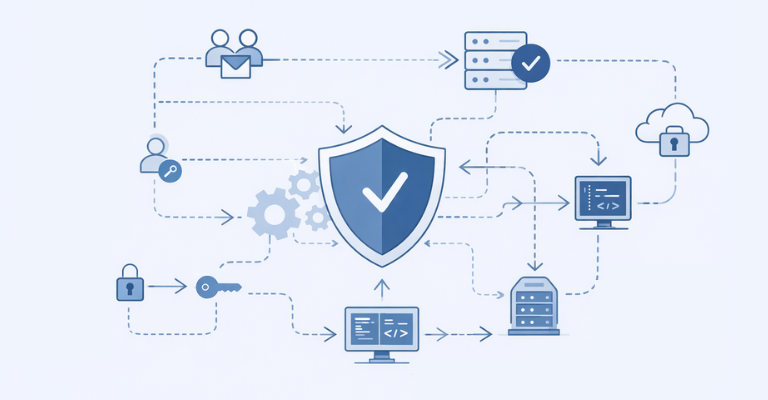
A centrally governed execution model ensures that every provisioning action runs under predefined and controlled conditions.
There is a common assumption that governance slows automation down, adding unnecessary layers of approval and preventing teams from developing and deploying new automation at the pace that business requires. In practice, the opposite is true.
When execution is governed by policy rather than by individual scripts, automation becomes easier to trust, and trusted automation can run consistently without supervision. This is what ultimately delivers real value and measurable return on investment, particularly as organizations move toward more autonomous, agent-driven operations.
A centralized control plane for automation provides the technical guardrails required to make zero-touch provisioning both safe and efficient:
- Permission management can be enforced centrally, allowing access to be assigned automatically by role and policy rather than through individual scripts running under personal accounts.
- Credentials can be stored securely in a central vault and applied to automation workflows without being exposed to users or embedded in code.
- Approval rules can be enforced consistently, with clear visibility into who authorized each action and when.
- Every step in an execution path can be logged in a single location, even when multiple tools and systems are involved, without requiring additional effort from the administrator.
With these controls in place, the reliability of automation no longer depends on who runs it or where it runs. Workflows can be trusted to produce the same result every time, regardless of whether they are triggered by a service request, a scheduled task, or an AI-driven process. This level of consistency is what allows end-to-end automation workflows, such as zero-touch provisioning, to operate safely at scale without the need for manual verification.
Provisioning in the Microsoft ecosystem often involves a complex combination of systems, including Active Directory, Entra ID, Microsoft 365, Exchange, and other connected services. Without a controlled execution layer, each integration introduces another opportunity for permissions to differ, credentials to fail, or logging to become incomplete.
When execution is routed through a policy-driven platform, these differences are handled automatically, allowing automation to remain predictable even as the environment grows more complex.
Zero-touch provisioning is therefore not the absence of control, but the result of having enough control that manual intervention is no longer required. With a governed execution model in place, agentic systems can operate autonomously with confidence, delivering the speed of automation without introducing unacceptable security risks or operational uncertainty.
How ScriptRunner Enables Fully Governed Zero-Touch Provisioning
ScriptRunner provides the controlled execution environment required to make zero-touch provisioning reliable in Microsoft environments. Instead of allowing scripts to execute from multiple tools, servers, or user accounts, all automation runs through a centralized, policy-driven platform. This ensures that every action follows the same rules, regardless of who triggers it or which system initiates the request.
By centralizing execution, ScriptRunner makes zero-touch provisioning predictable and safe to run at scale:
- Credentials are managed securely in a dedicated vault, so scripts no longer depend on individual administrator accounts.
- Permissions are assigned through roles and policies, allowing execution to be delegated without granting excessive privileges.
- Approval workflows can be built directly into the automation process, ensuring that required checks happen automatically rather than relying on manual intervention.
- Every execution is logged centrally, creating a complete and reliable audit trail for identity and access changes.
With this level of control in place, joiner, mover, and leaver processes can run automatically across Active Directory, Entra ID, Microsoft 365, Exchange, and other connected systems.
Agentic automation can apply the correct configurations at each step, confident that execution will occur under the right permissions and within the correct security boundaries. Requests are completed faster, errors are reduced, and administrators no longer need to monitor every action to ensure it behaved as expected.
Zero-touch provisioning only becomes practical when automation can be trusted to run consistently, securely, and without supervision. ScriptRunner provides the governance layer that makes this possible.
To learn how ScriptRunner helps you implement fully governed zero-touch provisioning across your Microsoft environment, book a meeting with our team.
FAQs
What is zero-touch provisioning in enterprise IT?
Zero-touch provisioning is an automated process where user accounts, permissions, and system access are created and configured without manual intervention. In Microsoft environments, this includes provisioning across services like Active Directory, Entra ID, and Microsoft 365.
How does zero-touch provisioning work?
Zero-touch provisioning works by combining automation scripts, workflows, and AI-driven systems to handle user onboarding tasks automatically. These systems interpret requests, apply policies, and execute actions such as account creation, role assignment, and access provisioning without requiring administrator input.
Why is zero-touch provisioning important for IT teams?
Zero-touch provisioning is important because it reduces manual workload, accelerates onboarding, improves consistency, and minimizes human error. It enables IT teams to scale operations efficiently while maintaining security and compliance across complex enterprise environments.
How can I get started with zero-touch provisioning?
To get started with zero-touch provisioning, organizations should standardize their automation workflows, centralize credential management, and implement governance controls. Using a centralized automation platform helps ensure consistent execution, secure access, and reliable outcomes across all provisioning processes.
Why does zero-touch provisioning fail without governance?
Zero-touch provisioning fails without governance because automation becomes unpredictable and difficult to trust. Without consistent execution, secure permissions, and auditability, IT teams must monitor and verify workflows manually, preventing true “zero-touch” operation.
How does ScriptRunner enable secure zero-touch provisioning?
ScriptRunner enables zero-touch provisioning by providing a centralized, policy-driven execution platform. It enforces role-based access control, secures credentials in a vault, standardizes automation workflows, and delivers full audit logging, ensuring provisioning processes run reliably and without manual intervention.